ZIYUAN

Enquiry
0
INQUIRY

 English
-
 English
 -
Français
-
한국어
-
日本語
-
IndonesiaName
-
Polski
-
Deutsch
-
Português
-
Español
-
Tiếng Việt


Send Your Inquiry Today
Thanks for Your Inquiry, We will Get back to You within 8 Working Hours!
Video Introduction of Ziyuan
Showcases Ziyuan’s company/factories & solar mounts: Balcony, Rail, etc. + manufacturing.
Invitation Letter
A Definitive Engineering Guide: How to Anchor Solar Panels for European, APAC & Middle East Markets
“
In solar project finance, the weakest link isn't the $500 panel; it's the $5 anchor. A single anchor failure is a catastrophic liability that can void warranties and threaten project bankability. This guide provides a definitive engineering analysis for B2B professionals on the high-stakes, region-specific challenges of solar anchoring. It dissects critical standards, roof types, and environmental loads for Europe, APAC, and MENA markets.
”
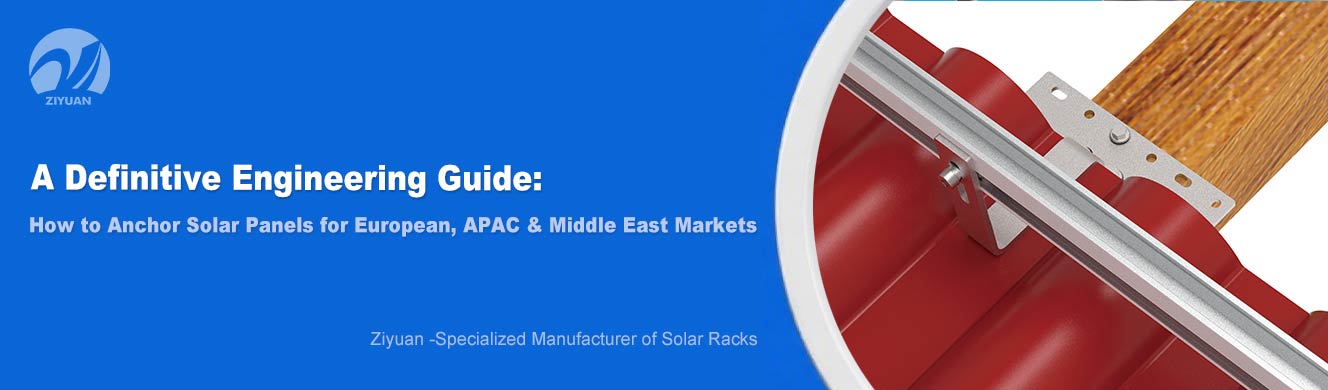
Table of Contents
- Introduction: The Critical Weak Link
- Section 1: The Universal Principles of Structural Roof Anchoring
- Section 2: Regional Deep Dive: Compliance and Engineering Considerations
- Section 3: A Specialized Solution: Mastering Tile Roof Anchoring with Ziyuan Solar
- Conclusion: Building Beyond Compliance: Choosing a Partner for Global Solar Projects
The Critical Weak Link: Why Roof Anchoring Dictates Project Bankability
In the calculus of solar project finance, investors, and asset managers are not primarily concerned with the failure of a $500 photovoltaic panel.
They are concerned with the failure of a $5 in. (12.7 cm) anchor.
This single component, the critical interface between the solar asset and the building structure, represents the weakest link and the highest point of leverage for project risk.
A panel is a replaceable asset; an anchor failure is a catastrophic liability.
The consequences of improper anchoring extend far beyond simple aesthetics or system downtime.
The downstream risks represent a direct threat to a project's bankability and an installer's reputation:
- Catastrophic Liability Risk: A system that detaches from a roof due to wind uplift becomes a significant hazard, capable of causing severe property damage or personal injury.
- Cascading Warranty Invalidation: Improper mounting, such as drilling through a historic slate tile or failing to seal a penetration, can instantly void the building's 20-year roof warranty. Simultaneously, excessive mechanical stress on a panel's frame from a poorly designed racking system can void the panel manufacturer's warranty.
- Structural Failure: An engineering miscalculation, such as underestimating snow load or failing to distribute point loads, can overload rafters, purlins, or trusses, leading to slow-onset structural damage or, in extreme cases, roof collapse.
- Water Ingress and Asset Degradation: Even a minor flaw in a penetration's waterproofing will not manifest immediately. It will present as a slow, chronic leak that allows moisture to seep into the roof deck, insulation, and structural members, leading to rot, mold, and costly, complex remediation years after the installation.
This guide moves beyond generic installation advice. It is an engineering analysis for B2B professionals—EPCs, installers, and project developers—on why a 'one-size-fits-all' approach to PV anchoring is obsolete and dangerous.
We will analyze how region-specific standards, diverse roof typologies, and harsh environmental conditions in Europe, APAC, and the Middle East demand highly specialized anchoring strategies and components.
Section 1: The Universal Principles of Structural Roof Anchoring
Before dissecting regional differences, it is crucial to establish the fundamental engineering principles that govern any sound anchoring system.
These laws of physics are non-negotiable and form the baseline for all subsequent design, compliance, and component selection.
1.1 Understanding the Load Triad: Uplift, Shear, and Downforce
An anchoring system is in a constant, 25-year battle with a dynamic combination of forces.
A design that only accounts for one of these is incomplete.
- Dead Load: This is the static, unchanging weight of the components themselves—the panels, racking, inverters, and the anchoring hardware. It is typically the least problematic force but serves as the baseline for all structural calculations.
- Live/Environmental Loads: This is where the real engineering challenge lies. These forces are dynamic, variable, and regionally specific.
-
Wind Load: This is not a single force. It is a complex vector that must be deconstructed.
- Uplift is the 'Bernoulli effect' force that sucks the array away from the roof, particularly potent at roof edges and corners.
- Shear is the lateral force that tries to slide the array parallel to the roof surface.
- Oscillation is the rapid, cyclical buffeting from wind gusts, which can induce material fatigue and loosen fixings over decades.
- Snow Load: This is a static, heavy-per-area downforce that tests the compressive strength of the mounting system and the load-bearing capacity of the roof structure (rafters or purlins) beneath it.
Amateur installers often focus only on the dead load (i.e., 'Will the roof hold the weight?').
Professional installers focus on the primary live load, such as wind uplift.
However, expert engineers—the audience for and purveyors of bankable projects—must design for load combinations.
The true test of an anchoring system is its ability to withstand, for example, a high snow load (downforce) combined with a significant lateral wind gust (shear), or to resist cyclical fatigue in a typhoon-prone region.
The anchoring component must be certified to handle these combined, multi-vector force calculations.
1.2 Principle 1: Anchoring to Structure, Not to Sheathing
This principle is absolute and non-negotiable. Roof sheathing—the layer of plywood, Oriented Strand Board (OSB), or decking that forms the roof's surface—is not a structural element for anchoring purposes.
It is designed to handle shear forces in its own plane and to transfer loads to the underlying structure.
It has negligible pull-out strength.
Any penetrative anchor must fasten securely into a structural member: a rafter, a truss, or a purlin.
Anchoring only to the sheathing is a structural defect, as wind uplift forces will easily pull the fasteners out, leading to a 'domino effect' failure of the entire array.
The primary challenge for an installer is locating these structural members 'blind' from above the roof.
1.3 Principle 2: The 25-Year Waterproofing Guarantee
A solar array is expected to generate power for 25 to 30 years.
The waterproofing for every penetration point must be engineered to last just as long.
A single failed $0.10 (0.09 euro) seal can compromise a multi-million dollar asset.
A robust waterproofing strategy relies on a multi-layered, belt-and-braces approach:
- Mechanical Flashing: This is the primary line of defense. A metal (typically aluminum or stainless steel) component is physically installed to direct the flow of water around and over the penetration point, integrating with the roof's existing water-shedding layers (e.g., shingles, tiles).
- Chemical Sealing: A high-grade, UV-stable, and roof-compatible sealant or mastic is applied under the flashing as a secondary barrier, adhering the flashing to the roof deck.
- Mechanical Gasket: A high-durometer EPDM (ethylene propylene diene monomer) gasket or bonded washer is compressed by the anchor bolt itself. This gasket must be rated for extreme temperature cycles (from $ -40^\circ C$ to over $80^\circ C$ in some regions) and long-term UV exposure without cracking or degrading.
1.4 Principle 3: Material Compatibility and Galvanic Corrosion
An uneducated material choice can create a self-destructing battery on the roof.
Galvanic corrosion occurs when two dissimilar metals (an anode and a cathode) are in electrical contact in the presence of an electrolyte (e.g., rainwater, or humid, salt-laden air).
A common mistake is using a galvanized steel (zinc-coated) fastener to secure an aluminum (e.g., 6005-T5) racking system.
In this galvanic pairing, the aluminum rack is the anode and will preferentially corrode, sacrificing itself to protect the cheaper bolt.
This can lead to the structural failure of the rack attachment point within a few years.
The professional standard to prevent this is to use materials that are chemically compatible.
The industry benchmark for high-quality racking and anchoring components is a combination of 6005-T5 or 6063-T5 aluminum alloys and high-grade stainless steel (SUS304 for general use, or marine-grade SUS316 for coastal and other highly corrosive environments).
Section 2: Regional Deep Dive: Compliance and Engineering Considerations
While the laws of physics are universal, building codes, environmental conditions, and dominant roofing practices are intensely local.
Applying a system engineered for a Southern California roof in a typhoon-prone region of Australia is not just a mistake;
it is professional negligence.
A B2B partner must demonstrate fluency in these regional nuances.
The following table provides a high-level strategic overview of the key differences between the European, APAC, and MENA markets.
The following table:
| Feature | Europe (EU/UK) | Asia-Pacific (APAC) | Middle East (MENA) |
|---|---|---|---|
| Key Standards | 'Eurocodes (EN 1991-1-3, EN 1991-1-4), TÜV Rheinland, MCS (UK)' | 'AS/NZS 1170.2 (Wind), CEC Guidelines (AU), JIS (Japan), IEC 61215' | 'Local utility mandates (e.g., DEWA, KAHRAMAA), IEC, IBC (International Building Code)' |
| Dominant Roof Types | 'Ceramic/Clay tiles (Roman, Pantile), Slate, Flat (Bitumen)' | 'Metal (Trapezoidal/Corrugated), Concrete tile, Flat' | 'Flat (Concrete), Limited Tile Roofs' |
| Primary Engineering Challenge | 'Snow loading (Scandinavia), Tile complexity, Heritage building preservation' | 'Cyclonic/Typhoon wind loads, High humidity (corrosion), Seismic activity' | 'Extreme heat (thermal expansion), Sand/dust abrasion, System cooling' |
2.1 Anchoring for Europe: Precision, Heritage, and Snow Load
Standards Analysis:
Compliance in Europe is governed by a framework of harmonized standards.
- Eurocodes: These are not simple pass/fail documents. They are a sophisticated set of design methodologies.
- Specifically for solar anchoring, engineers must reference Eurocode 1: Actions on structures, which includes EN 1991-1-4 (Wind actions) and EN 1991-1-3 (Snow loads).
- These provide the calculation methods and regional maps to determine the precise forces an anchor must withstand in a specific location, from the high-wind zones of the UK coast to the heavy-snow regions of the Alps.
- TÜV Rheinland: While not a standard itself, a TÜV certification (e.g., from TÜV Rheinland) is a powerful market signal, especially in Germany.
- It acts as an independent, third-party guarantee that a component (like a roof hook) has been rigorously tested against the relevant Eurocode methodologies for mechanical strength and safety.
Roofing & Environmental Challenge:
The dominant challenge in much of Europe (e.g., Germany, UK, France, Italy) is not raw force, but finesse.
A significant portion of the building stock, both residential and commercial, features pitched roofs with ceramic, clay, or slate tiles.
These roofing materials are often centuries old, brittle, and irreplaceable.
A 'brute force' American-style approach of drilling a large-diameter penetration through a tile and sealing it with bitumen is completely unacceptable.
It will crack the tile, void the roof's integrity, and destroy client trust.
The engineering solution must therefore be one of bypass, not penetration.
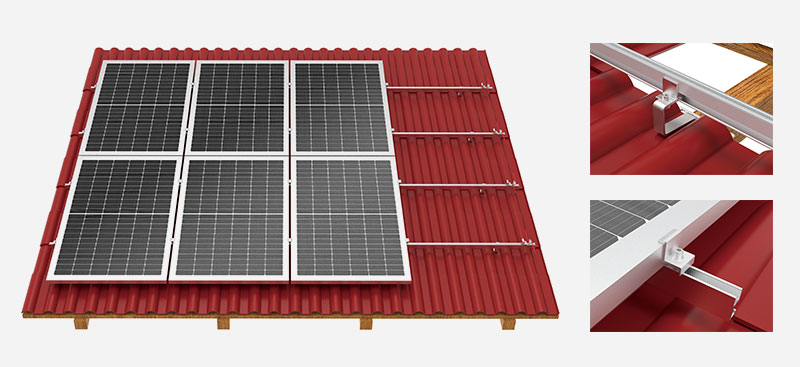
This requires specialized, adjustable tile hooks. These components are designed to be fixed directly to the rafter, with a long arm that extends out from underneath one tile and over the top of the tile below it, creating a mounting point above the tile line.
This technique requires zero cutting, drilling, or grinding of the tile itself, perfectly preserving the roof's waterproofing layer and structural integrity.
2.2 Anchoring for APAC: Cyclone-Proofing and Corrosion Resistance
Standards Analysis:
The APAC region is defined by extreme weather, demanding a focus on structural resilience.
- AS/NZS 1170.2 (Australia/New Zealand): This standard is a global benchmark for wind load engineering.
- The Clean Energy Council (CEC) guidelines in Australia further build on this, classifying the continent into Wind Regions A, B, C, and D. Regions C and D are designated 'Cyclonic.'
- Cyclonic (Region C & D): Anchoring systems in these regions are not just 'stronger.'
- They must be fundamentally different, often requiring mechanical locking mechanisms and significantly more anchor points per array to prevent catastrophic failure under extreme, cyclical uplift forces.
- IEC 61215/61730: While these are panel testing standards, their mechanical load and salt-mist tests inform the requirements for the mounting system, ensuring the racking does not induce stresses that would void the panel warranty.
Roofing & Environmental Challenge:
The most common roofing material in Australia and Southeast Asia is profiled metal sheeting (trapezoidal or corrugated).
This presents a unique and often misunderstood challenge.
The point of failure on a metal roof is frequently not the anchor itself, but the substrate to which it is attached.
The metal sheeting is typically thin (e.g., $0.42\text{ mm}$ - $0.48\text{ mm}$) and is not a structural member.
A non-compliant installation involves fixing the anchor (e.g., an L-foot) only to the thin metal sheet using self-tapping screws.
In a high-wind event, the uplift force will simply rip the screws and a strip of the sheeting directly off the roof, leaving the anchor and panel attached to it.
A compliant, E-E-A-T-driven installation must anchor through the metal sheeting and into the structural purlin (steel or timber) below.
This requires longer, specialized fasteners, precision alignment, and specialized L-feet or mini-rails designed for this purpose.
Furthermore, the high-humidity, high-salinity coastal environments of APAC mandate the use of marine-grade SUS316 stainless steel for all fasteners and hooks to combat aggressive corrosion, as discussed in Principle 1.4.
2.3 Anchoring for the Middle East (MENA): Battling Thermal Expansion and Sand
Standards Analysis:
The MENA market is characterized by strong, localized utility mandates that often exceed general international codes.
- DEWA (Dubai Electricity and Water Authority): In Dubai, DEWA's regulations are paramount.
- These rules are highly prescriptive, covering everything from electrical safety to the material durability of components.
- KAHRAMAA (Qatar): Similar to DEWA, Qatar's utility has specific requirements that must be met for grid connection.
- IBC (International Building Code): In the absence of a specific local code, many Gulf Cooperation Council (GCC) nations default to the U.S.-based IBC for structural and wind load calculations.
Roofing & Environmental Challenge:
The vast majority of commercial and many residential buildings in MENA feature flat concrete roofs.
This creates a primary engineering dilemma: ballasted vs. penetrated systems.
A ballasted system uses heavy concrete blocks to hold the array in place, avoiding penetrations.
A penetrated system is mechanically anchored into the concrete slab.
While wind is a factor, the defining engineering challenge in MENA is extreme heat.
Surface temperatures on a dark roof in Dubai or Riyadh can exceed $80^\circ C$ ($176^\circ F$).
This introduces a threat that is often more destructive than wind: thermal expansion.
Consider the physics: an aluminum rail (high coefficient of thermal expansion) is fixed to a concrete slab (low coefficient) using a steel anchor (medium coefficient).
The system cycles from $25^\circ C$ at night to $80^\circ C$ at its peak.
This daily cycle induces constant, powerful micro-movements (expansion and contraction) in the entire array.
If a system is rigidly penetrated, these thermal fatigue stresses can:
- Cause EPDM gaskets and chemical seals to crack and fail prematurely.
- Slowly 'walk' anchors out of their fixings.
- Induce stress in the panel frames, leading to micro-cracks.
Therefore, an anchoring system for a penetrated MENA concrete roof must be designed with thermal expansion in mind, incorporating expansion joints in long rail runs and using flexible anchoring points that can accommodate this daily movement without fatiguing.
All non-metal components (gaskets, wire clips) must be high-temperature, UV-rated, and sand-abrasion-resistant.
Section 3: A Specialized Solution: Mastering Tile Roof Anchoring with Ziyuan Solar
As demonstrated in Section 2.1, the pitched tile roofs common in Europe—and also prevalent in key APAC markets like Australia and Japan—present the most complex and delicate anchoring challenge.
They demand a solution that respects the roof's integrity while providing uncompromising, 25-year structural strength.
A simple L-foot or bolt is not a solution; it is a liability.
This challenge is defined by a convergence of problems:
- Fragility: Ceramic, clay, and slate tiles are brittle and will crack under point-loads or the impact of a drill.
- Uneven Profile: 'S' shape, Roman, or Pantile profiles create a highly uneven surface, making a flat, stable mount impossible without specialized hardware.
- Waterproofing: The interlocking, overlapping nature of tiles is a sophisticated, non-sealed water-shedding system. Disrupting this system guarantees a leak.
- Structural Location: The rafter is hidden beneath multiple layers, requiring precision to locate and engage.
The Engineering-Led Solution: Ziyuan Solar's Tile Roof Series
Addressing this complex problem requires a purpose-built system. Ziyuan Solar's line of specialized tile roof anchoring solutions is engineered to solve these exact challenges, moving beyond simple compliance to provide a truly professional solution.
Feature 1: Adjustable Stainless Steel (SUS304) Roof Hooks
Engineering Benefit: Our hooks are designed with multi-axis adjustability (both in height and lateral position).
This is a critical feature. It allows the installer to perfectly align the hook with the rafter (solving the structural location problem) and adjust the arm height so it exits cleanly between the tile overlap.
This eliminates the need for cutting or grinding the tile, solving the fragility and waterproofing problems simultaneously.
It is the 'finesse-led' solution demanded by European heritage markets.
Feature 2: Eurocode-Compliant Engineering and Load Data
Engineering Benefit: These hooks are not just bent pieces of metal; they are engineered structural components.
As discussed in Section 2.1, compliance with Eurocodes is essential.
We provide comprehensive technical data sheets detailing the tested ultimate and allowable loads (uplift, shear, downforce) for our hooks.
This empowers your engineering team to design systems with full confidence, knowing the components are certified to withstand the calculated wind and snow loads for their specific project location.
Feature 3: Full SUS304 Construction and Multi-Layered Sealing
Engineering Benefit: The entire hook and its fastening components are fabricated from high-grade SUS304 stainless steel.
This directly addresses Principle 1.4 (Material Compatibility), guaranteeing a 25-year life free from galvanic or atmospheric corrosion, even in damp European or humid APAC climates.
The rafter fixings (e.g., hanger bolts) are supplied with thick, UV-rated EPDM gaskets and optional formed-metal flashing, creating the multi-layered, 25-year waterproofing system required by Principle 1.3.
Conclusion: Building Beyond Compliance: Choosing a Partner for Global Solar Projects
The analysis is clear: anchoring a solar array is not a commoditized afterthought.
It is the single most critical engineering decision in a rooftop PV project.
A 'one-size-fits-all' approach is no longer viable in a global market defined by diverse and demanding standards.
An anchor that is non-compliant with Eurocodes or lacks a TÜV test certificate is un-sellable in Germany.
An anchor system that fastens only to the metal sheeting, rather than the purlins, is a non-starter for any project governed by Australia's AS/NZS 1170.2 cyclonic code.
A component whose EPDM gasket degrades under the extreme $80^\circ C$ heat of the MENA region will fail, regardless of its mechanical strength.
Choosing a mounting component supplier is not about finding the lowest price-per-piece.
It is about finding an engineering partner who demonstrates a deep, nuanced understanding of your target market's specific challenges.
It is about sourcing components that are not just compliant, but engineered for a 25-year lifespan in those harsh, specific environments.
Our engineers are ready to review your project specifications for Europe, APAC, or the Middle East.
Author:
Ethan Cheng









If you're If you’re interested in our products our products, kindly provide your details including contact information, required items, quantity or capacity, construction timeframe, etc. We'll respond within 24 hours.

We have first-class production engineers, technicians and R & D team offering innovative design and
reliable solution to our customers based on years of experiences.

点击右上角
分享给朋友吧
CONTACT
 Tel/Fax:86 18030156785
 WhatsApp:18030156785
 Add: Room 808, NO.31 Anling Second Road Huli
Districtd, Xiamen, China
HOT TAGS
SUBSCRIBE US
Please read on, stay posted, subscribe, and wewelcome
you to tell us what you think.
Offcial Wechat:
Copyright © : 2015-2026 XIAMEN ZIYUAN TECH CO.,LTD All Rights Reserved. XML | PRIVACY POLICY | IPV6 NEXTWORK SUPPORTED
We have first-class production engineers, technicians and R & D team offering innovative design and reliable solution to our customers based on years of experiences.
点击右上角
分享给朋友吧
CONTACT US
Tel/Fax:86 18030156785
WhatsApp:18030156785
 Email: admin@ziyuansolar.com
Add: Room 808, NO.31 Anling Second Road Huli Districtd, Xiamen, China
Copyright © : 2015-2025 XIAMEN ZIYUAN TECH CO.,LTD All Rights Reserved.
 Ziyuan Energy