ZIYUAN

Enquiry
0
INQUIRY

 English
-
 English
 -
Français
-
한국어
-
日本語
-
IndonesiaName
-
Polski
-
Deutsch
-
Português
-
Español
-
Tiếng Việt


Send Your Inquiry Today
Thanks for Your Inquiry, We will Get back to You within 8 Working Hours!
Video Introduction of Ziyuan
Showcases Ziyuan’s company/factories & solar mounts: Balcony, Rail, etc. + manufacturing.
Invitation Letter
What Is A Ground-Mount Solar System?
“
Learn how ground-mount solar systems deliver flexible, high-output renewable energy for homes, farms, and commercial sites. Discover installation types, pros and cons, and planning tips to maximize solar ROI and reliability in every environment.
”
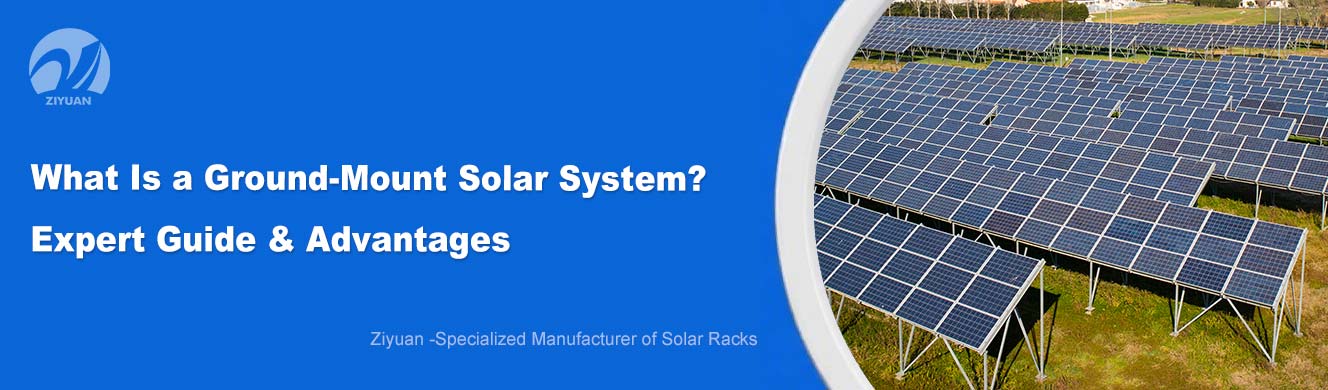
Table of Contents
Ground-mount solar systems represent an increasingly popular alternative to traditional rooftop solar, ideally suited for projects where maximum energy production, flexibility of location, or long-term scalability is key. While rooftop panels remain the default choice for many homeowners, the limitations of roof direction, angle, strength, and shadow make ground-mount solar the smarter option for countless residential, commercial, and agricultural users today.
Understanding Ground-Mount Solar Technology
A ground-mount solar system is a photovoltaic setup designed with panels positioned at ground level, supported by engineered metal racks and foundations. Instead of relying on rooftop surfaces, these systems utilize the most open spaces on a property, giving installers and owners freedom to optimize orientation and tilt for peak energy yield. Ground arrays are highly versatile and can be engineered for small gardens, large farms, industrial sites, or utility-scale solar farms.
Beyond increased flexibility, ground-mounted panels offer a structurally independent solution—no modifications to buildings required. This allows for larger system sizes and easy upgrades in the future, something not always possible with rooftop installations.
Foundation Types and Structural Supports
To secure panels to the ground, three principal foundation methods are employed:
- Pole mounts: Use vertical steel poles anchored in earth or concrete. Panels are elevated, allowing space below for crops, animals, or utility infrastructure. Pole-mount systems often support tracking devices that dynamically adjust for optimal sunlight.
- Rack/rail-based mounts: Feature a fixed metal framework, horizontally arranged for stable support and precise tilt optimization. These are popular for domestic and smaller commercial arrays. Some rack systems can be manually adjusted seasonally for improved performance.
- Ballasted mounts: Deploy concrete, stone, or steel blocks that use mass rather than earth penetration for stability. Ideal for sites where drilling is not allowed or soil conditions would make deep anchoring problematic. This type is increasingly used on landfills, brownfields, or the edges of buildings.
Key Advantages of Ground-Mounted Solar
There are several strong reasons to consider a ground-mount system instead of rooftop solar:
- Ideal Solar Angles: Free from roof limitations, arrays can be tilted for optimal sunlight all day and year-round, boosting output by up to 35% versus typical rooftop configurations.
- Easy Maintenance: Panels at ground level are easier to access, clean, and repair, minimizing long-term service costs and risks.
- Greater Energy Output: Improved cooling from natural airflow and ideal positioning results in consistently higher panel efficiency.
- Scalability and Expansion: Systems are easier to expand as power needs grow, simply by adding racks or additional land area.
- No Roof Constraints: Owners avoid concerns over roof warranty, structure, shading, or limited roof space which can all restrict rooftop system effectiveness.
- Tracking Technology: Ground arrays can utilize advanced single- or dual-axis trackers, automatically following the sun to increase generation by 20-40%. This is rarely feasible on roofs.
- Bifacial Panels: These special panels absorb light on both sides, generating 10–30% more electricity when installed with open, reflective ground surfaces—a configuration far easier with ground mounts.
Where and How Can Ground-Mount Solar Be Applied?
Ground-mounted solar is especially well suited for:
- Properties with large, unshaded outdoor areas
- Farms or agricultural settings
- Businesses with land adjacent to buildings
- Utility-scale solar parks/community energy projects
- Off-grid cabins and eco installations
Space, Planning, and Installation Process
A typical 4-5kW home system requires 25–35 m² of unobstructed ground. The ideal site is open from east to west with little shading. Slope can be accommodated, but not excessive. Larger commercial installations may use acres in size.
Professional ground-mount installation involves several steps:
- Site Assessment: Experts calculate sunlight exposure, confirm minimal shading, and test soil for stability.
- System Design: Engineers determine tilt, orientation, structure type, and calculate required foundations for wind/snow loads.
- Foundation Installation: Poles may be driven or poured into concrete; racks are bolted and aligned; ballasts placed for weight.
- Mount and Panel Assembly: Frames are assembled and modules secured.
- Electrical Integration: Panels are connected via cabling to an inverter and linked to the building grid or battery storage.
- Testing/Commissioning: System undergoes safety and performance checks before activation.
Pros and Cons Comparison
| Factor | Ground-Mount Solar | Rooftop Solar |
|---|---|---|
| Max Sun Exposure | Yes, free-tilt | Limited by roof |
| Structural Limits | No roof needed | Roof must be fit |
| Ideal for | Large/open land | Most homes |
| Expansion Capability | High | Limited |
| Advanced Tracking | Yes | Rarely feasible |
| Maintenance | Easy, ground level | Risky, roofwork |
| Cooling Efficiency | Superior airflow | May overheat |
| Initial Cost | Higher per watt | Lower |
| Aesthetics | Visible in yard/field | Out of sight |
Planning Permission and Regulations
Most residential installations below 9m² won't require planning permission, but larger commercial or community arrays do. Factors considered include total height (usually<4m), proximity to boundaries, and local environmental impact. Additional permits may be needed for pole mounts or large-scale sites.
Conclusion
Ground-mount solar systems offer a modern, efficient, and flexible solution for anyone seeking to maximize renewable energy production, especially where rooftop options fall short. When properly engineered and installed, these systems deliver consistently higher output, easier maintenance, and future-proof scalability—key reasons why ground-mounted arrays are rapidly gaining recognition in homes, agriculture, and industry across the world.
With careful attention to site selection, system design, and local regulations, property owners can invest in ground-mount solar with confidence, optimizing both their energy future and the long-term value of their land.
Author:
Xiamen Ziyuan Energy Technology Co., LTD









If you're If you’re interested in our products our products, kindly provide your details including contact information, required items, quantity or capacity, construction timeframe, etc. We'll respond within 24 hours.

We have first-class production engineers, technicians and R & D team offering innovative design and
reliable solution to our customers based on years of experiences.

点击右上角
分享给朋友吧
CONTACT
 Tel/Fax:86 18030156785
 WhatsApp:18030156785
 Add: Room 808, NO.31 Anling Second Road Huli
Districtd, Xiamen, China
HOT TAGS
SUBSCRIBE US
Please read on, stay posted, subscribe, and wewelcome
you to tell us what you think.
Offcial Wechat:
Copyright © : 2015-2026 XIAMEN ZIYUAN TECH CO.,LTD All Rights Reserved. XML | PRIVACY POLICY | IPV6 NEXTWORK SUPPORTED
We have first-class production engineers, technicians and R & D team offering innovative design and reliable solution to our customers based on years of experiences.
点击右上角
分享给朋友吧
CONTACT US
Tel/Fax:86 18030156785
WhatsApp:18030156785
 Email: admin@ziyuansolar.com
Add: Room 808, NO.31 Anling Second Road Huli Districtd, Xiamen, China
Copyright © : 2015-2025 XIAMEN ZIYUAN TECH CO.,LTD All Rights Reserved.
 Ziyuan Energy